A strong professional reputation no longer exists only inside an office, across a meeting table or within a printed CV. Today, people often form their first impression of a professional long before a conversation takes place. They search a name, review a career history, look at achievements and try to understand what that person actually brings to the table. For many professionals, LinkedIn sits at the centre of that process.
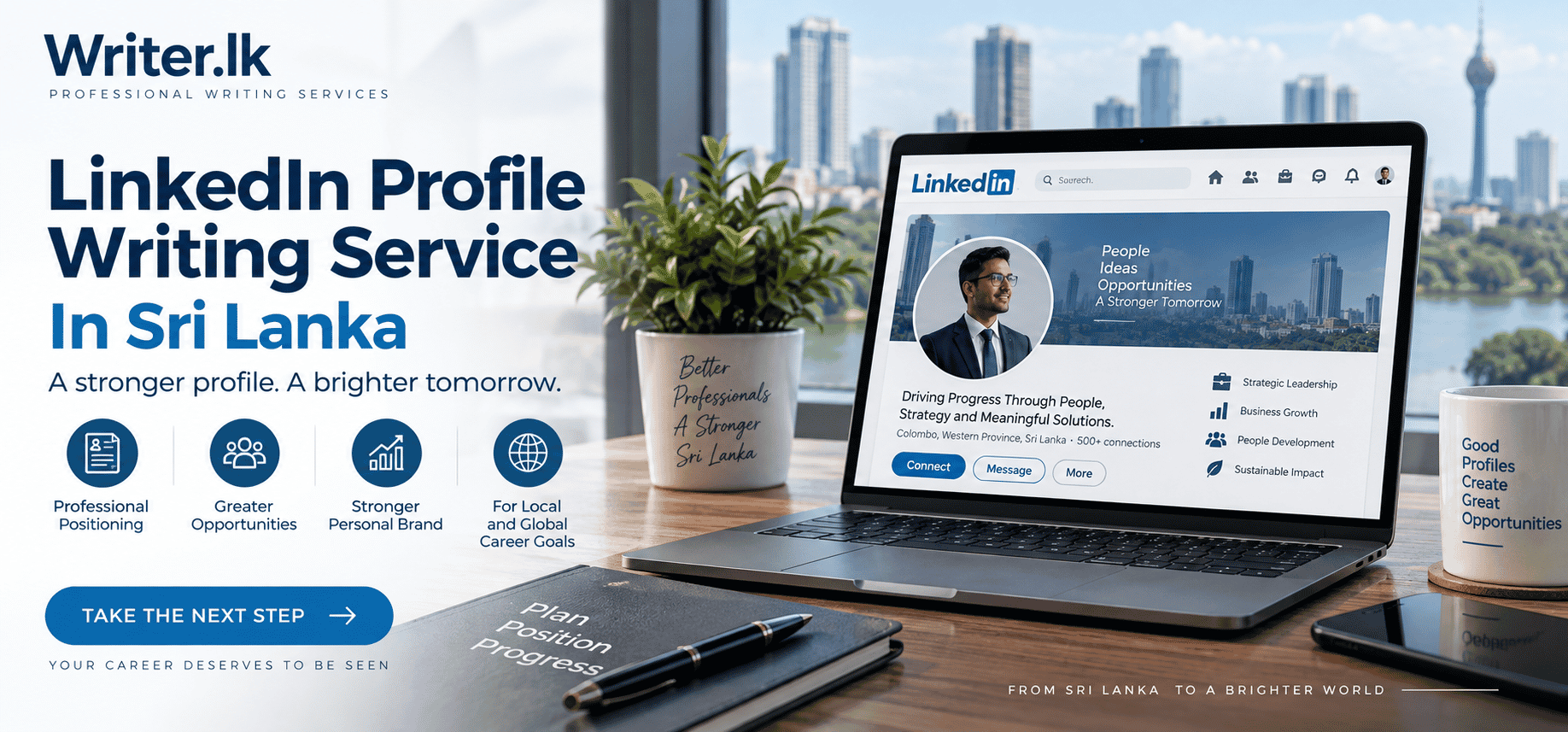
A professional LinkedIn Profile Writing Service in Sri Lanka helps turn that digital first impression into a clear representation of your career, expertise and professional direction. At Writer.lk, we develop LinkedIn profiles for professionals who want more than a completed online résumé. We create profiles that communicate professional value with clarity, credibility and purpose.
This matters because LinkedIn has changed considerably from its early role as an online employment platform. It now functions as a professional identity platform where recruiters identify candidates, companies evaluate potential hires, executives establish authority, consultants build credibility and business decision-makers assess the people behind organisations.
A poorly written profile can therefore create a gap between what a person has achieved and how the market perceives them. Closing that gap is where professional LinkedIn profile writing becomes valuable.
Your Career May Be Stronger Than Your LinkedIn Profile Suggests
This is a common situation.
A professional may have spent ten or fifteen years building teams, managing clients, leading projects, improving operations or developing businesses. Their LinkedIn profile, however, may still contain little more than job titles, employment dates and a few generic descriptions copied from old job specifications.
The experience exists. The profile simply fails to communicate it.
Consider a senior manager who has worked across business development, operations and strategic projects. A profile that says “responsible for business development and client management” tells the reader almost nothing about the level at which that person operates.
Did the manager enter new markets? Build major accounts? Lead cross-functional teams? Improve revenue? Restructure a department? Develop partnerships? Manage complex stakeholder relationships?
Those details shape professional value.
This is why effective LinkedIn writing starts with understanding the person rather than filling sections with attractive words.
LinkedIn Is Not Simply an Online CV
A CV and a LinkedIn profile often contain similar information, but they perform different jobs.
A CV usually targets a particular vacancy or employment opportunity. The reader receives it within a specific context. A LinkedIn profile operates continuously and reaches a much broader audience. LinkedIn Profile Writing Service in Sri Lanka.
A recruiter may discover it while searching for a particular skill. A prospective client may review it after receiving an introduction. A business partner may check it before a meeting. An employer may compare it against an application. An investor may want to understand the background of a founder.
The profile therefore needs to answer a broader question:
Who is this professional, and why should I take them seriously?
That answer should become clear without exaggeration, empty claims or excessive corporate jargon.
Professional LinkedIn writing brings together career history, expertise, achievements and positioning to create a coherent professional identity.
The Headline Creates the First Positioning Decision
One of the smallest sections of a LinkedIn profile often carries the greatest strategic importance.
The headline appears beside a person’s name throughout LinkedIn. Yet many professionals use only their current job title.
“Manager at ABC Company” may be technically correct, but it gives the reader very little information.
A stronger headline can communicate function, expertise and professional direction within a limited space. The exact structure depends on the individual.
A corporate communications professional, for example, may need to highlight communications, stakeholder engagement and reputation management. A finance professional may need to emphasise financial planning, reporting and commercial analysis. A consultant may need to position around a specific area of advisory expertise.
The objective is not to squeeze as many keywords as possible into one line. It is to establish immediate professional relevance.
Our LinkedIn Profile Writing Service in Sri Lanka approaches the headline as a positioning statement rather than a decorative introduction.
The About Section Should Tell a Professional Story
The About section provides room to explain the professional behind the job titles.
Unfortunately, it often becomes one of two things: a long autobiography or a collection of claims such as “dynamic,” “results-driven,” “passionate” and “highly motivated.”
Neither approach tells the reader much.
A well-written About section creates a concise professional narrative. It can explain where the person operates professionally, what experience they bring, the problems they understand and the value they can contribute.
For a senior professional, the story may show progression from functional expertise into leadership. For an entrepreneur, it may explain the commercial experience behind the ventures they lead. For a consultant, it may establish a clear advisory focus. For someone changing careers, it can connect previous experience with the direction they now want to pursue.
The language should sound credible because credibility carries more weight than self-promotion.
Experience Should Show Contribution, Not Just Responsibility
This is where many LinkedIn profiles lose their impact.
A job description tells people what a position normally involves. A professional profile should tell people what you actually did in that position.
There is a significant difference.
“Responsible for managing corporate clients” describes a duty.
“Managed relationships with corporate accounts across multiple sectors while identifying opportunities for account growth and long-term engagement” communicates a broader professional contribution.
Where appropriate, experience sections can also demonstrate scale. Revenue figures, team sizes, geographical coverage, project values, growth percentages and measurable improvements can add context when the professional can substantiate them.
Not every achievement needs a number. Strategic contributions also matter. Developing a new process, launching a service, leading organisational change, entering a market or improving stakeholder communication can demonstrate significant value without a percentage attached.
At Writer.lk, we focus on turning employment history into evidence of professional capability.
Keywords Matter, but Human Readers Still Matter More
LinkedIn search gives keywords an important role.
Recruiters and other users often search using job titles, industries, technical skills, qualifications and specialist terms. A profile that completely ignores relevant terminology may reduce its discoverability.
However, keyword optimisation should never destroy readability.
Repeating the same phrases unnaturally across a headline, About section and employment history does not create a strong profile. It makes the writing feel mechanical.
The better approach identifies terms that genuinely belong to the professional’s career and integrates them naturally across relevant sections.
For someone seeking management positions, these may relate to leadership, strategy, operations or commercial management. A technology professional may require specific systems, platforms or technical disciplines. A governance professional may need terminology relating to compliance, boards, risk and corporate governance.
Good LinkedIn optimisation supports positioning. It should never replace it.
Different Career Stages Require Different Profiles
There is no universal LinkedIn template that works equally well for everyone.
A graduate entering the employment market needs to communicate potential, education, relevant exposure and developing skills.
A mid-career professional needs to show progression and increasing responsibility.
A senior executive needs to communicate leadership scope, strategic contribution and organisational impact.
An entrepreneur needs to establish the credibility behind the businesses they represent.
A consultant needs to make expertise immediately understandable to prospective clients and professional contacts.
Professionals preparing for an international move face another challenge. Their existing titles and experience may not translate perfectly into the terminology used in the market they want to enter. In those cases, the profile needs to remain factually accurate while making the person’s experience understandable to the target audience.
That level of positioning requires more than replacing a few sentences with polished wording.
LinkedIn and Your CV Need to Support the Same Professional Identity
A recruiter who receives a CV can open LinkedIn within seconds.
If the two present completely different versions of the same career, questions can arise.
This does not mean they need identical wording. They should not.
The CV can target a specific opportunity, while LinkedIn can present a broader professional identity. However, job titles, dates, qualifications and major career facts should remain consistent. More importantly, both should communicate a compatible professional direction.
For example, someone targeting senior commercial positions should not have a CV focused on commercial leadership while their LinkedIn profile presents them primarily as a general administrator.
Professional branding works best when every major document points towards the same credible identity.
Senior Professionals Need Restraint as Much as Strong Writing
The more senior the professional, the more important restraint becomes.
Executives rarely benefit from profiles filled with inflated claims. Statements such as “visionary leader,” “world-class strategist” or “unparalleled expert” can weaken credibility when the career history does not demonstrate those qualities independently.
Strong executive profiles usually rely on evidence.
They show the scale of responsibility, industries covered, markets entered, organisations led, transformations managed and decisions influenced.
The reader can then reach the conclusion without being told what to think.
That principle shapes our approach to senior LinkedIn profile writing. Professional authority should come from substance.
Who Can Benefit From Professional LinkedIn Profile Writing?
A professionally written profile can support people across many career situations.
Job seekers may need stronger positioning before entering a competitive recruitment process. Executives may want a profile that reflects their current seniority. Entrepreneurs may need greater credibility when approaching clients, investors or partners. Consultants may want to establish a clearer area of expertise. Professionals planning to enter markets such as the UK, UAE, Saudi Arabia, Australia or Canada may need to present their experience to an international audience.
The common issue remains the same: valuable experience does not automatically communicate itself.
Someone has to structure it.
How Writer.lk Approaches LinkedIn Profile Writing
Our process starts with the professional rather than a generic template.
We review the person’s existing profile, career history, CV and intended direction. We identify the strongest parts of the background and areas where the current profile undersells the person.
We then establish positioning.
What should a recruiter understand within the first few seconds? What expertise deserves greater visibility? Which achievements demonstrate capability? Which career details support the person’s next move? Which keywords belong naturally within the profile?
From there, we develop the core LinkedIn content, including the professional headline, About section and experience descriptions. Where relevant, we can also recommend improvements to skills, profile structure and overall presentation.
The result should sound like the professional it represents: credible, experienced and clear.
A Strong LinkedIn Profile Should Create the Right Conversation
The purpose of LinkedIn profile writing is not to make everyone look impressive.
It is to make the right professional value visible.
For one person, that may mean helping recruiters recognise ten years of management experience. For another, it may mean repositioning a founder for a corporate career. For an executive, it may mean demonstrating leadership beyond a job title. For a consultant, it may mean showing potential clients exactly where their expertise lies.
The profile succeeds when the right reader quickly understands why that professional is relevant.
That is the standard we apply to every LinkedIn Profile Writing Service in Sri Lanka assignment at Writer.lk.
Your LinkedIn profile already tells a story about your career. The question is whether it tells the right one.
If your experience has grown but your profile has not grown with it, Writer.lk can help you rebuild your LinkedIn presence around your actual professional value, career direction and target market.
Writer.lk – Professional LinkedIn Profile Writing in Sri Lanka
For LinkedIn profile writing, CV development and professional personal branding support, contact Writer.lk.
Call / WhatsApp: 077 765 3945
Email: writersrilanka@gmail.com